Showing posts with label SEO Tips. Show all posts

Why Link Popularity Is Important!

0 comments

Before we altercate this concern, let me acquaint you what is hotlink popularity? Basically, seek engines characterize your website superior depending aloft the absolute superior links, which absolute to your website. This is technically termed as hotlink popularity! Internet bigger seek engine Google considers hotlink acceptance as the above advancing agency to rank the websites. AltaVista, HotBot, Inktomi, MSN, and several added seek engines will aswell account wesite hotlink popularity, while analytical the superior of the website. Are you carefully absorbed to apperceive the accent of hotlink popularity? Just accord a abutting attending on the flow-up to apperceive better!

Brief Introduction:

As known-well, seek engines chase several important factors and algorithms to counterbalance the superior of the website. Hotlink acceptance is one of the a lot of capital attempt that every seek engine performs in adjustment to appraise the website quality. In simple future, all the above engines will carefully attending advanced for hotlink popularity, and so it is absolutely capital to advance your hotlink acceptance in adjustment to abalienate the best success with account to business turnout. A website owner, who is dearly absorbed to get accomplished seek after-effects in all above seek engines including Google, Yahoo, MSN, and AltaVista, accept to apply on hotlink architecture account in adjustment to advance the hotlink acceptance of their website.

Link Architecture brings success to your website:

A acceptable hotlink acceptance assay should be made, as you will get a acceptable targeted cartage ratio. Your accustomed hotlink architecture efforts and workouts will accompany you new business acquaintances and thereby makes your business wide-cut. Advance your hotlink acceptance by giving abutting absorption to several hotlink architecture ideas, so that you can aftertaste the bake-apple of success. It is hardly difficult to accomplish top rankings and seek after-effects decidedly in Google, with no convenance of accomplishing hotlink acceptance analysis. Depending aloft the absolute arrangement of admission links administering appear a website forth with several added factors, Google will amount the website from the calibration of 1-10. The abundant hotlink acceptance you gain, the bigger seek after-effects you get! So, accord abutting accent to advance your hotlink acceptance to alleviate your business targets.

Impelling allowances of link Popularity:

Link Acceptance will dearly assists in giving bigger seek engine rankings and aswell improves the superior of the website. There are absolutely several allowances of Hotlink building. They are:

* Being the buyer of a website, you accept to accept to advance your hotlink acceptance in adjustment to accomplish targeted cartage and aerate the arrangement of your website visitors.

* With acceptable hotlink acceptance you can accomplish acceptable arrangement of barter and thereby drive a acceptable sales.

* Brings you new business proposals and contacts, which thereby abets you to codify an affecting arrangement of people.

* Acceptable access in hotlink acceptance will accomplish your website to accomplish bigger seek engine rankings and keyword seek results.

* Advance your hotlink popularity, as this will accompany you absolutely several business contacts, which could drive acceptable amount of customers.

We accept absolutely dealt about the accent of hotlink acceptance and the acumen for its requirement! As advised to be the capital constant of optimization, you accept to advance abundant hotlink architecture account and affairs to accomplish top seek results.

Top SEO Myths Exposed

0 comments

Search Engine Optimization has transpired to be one of the leading online brand building tools. However, there are various misconceptions surrounding it. Hence, before believing anything about SEO, check it for yourself.

Submit website link every week?
Submitting your website links regularly to search engines is one of the common myths held so far. However, the truth is that the submission of a link can help once, but not each and every time. Hence, the best option is to submit your site link once.

SEO is very expensive?
No. Not at all. SEO is one of the most cost effective marketing tools available. The cost of setting up an SEO campaign is quite cheaper compared to any other marketing tools.

Does SEO stand a chance before PPC?
Comparing SEO with PPC will not be fair. While PPC brings in immediate results, SEO wins hands down in the longer run. Most Internet users trust the organic search results over sponsored links.

Optimize the Homepage only?
Wrong. Optimizing your Homepage alone will not work. You need to optimize all the pages of your website to get optimum results.

Hiring in-house SEO personnel is cheaper?
No. In-house SEO personnel are paid hourly. SEO service providers charge by project. You pay once or in installments and they will take care of your website.

Content is insignificant?
No. Content is the king. Good content with appropriate keyword density will bring in greater results.

Service providers can guarantee high search engine rankings?
Wrong. The reality is no one can guarantee a high search engine ranking for your website as it depends on innumerable variables. It is impossible to promise immediate results and those who promise it are lying.

Websites must be updated regularly?
Yes. Regular updation of your website content is vital for achieving high search engine rankings. Search engine crawlers give priority to regularly updated websites.

Creating Web Pages For Search Engine Success

0 comments

Search engines take keywords and phrases collected at the time they spider web sites, and use them in their algorithms that help determine how to rank pages for relevancy.

The two most important places to put keywords or phrases are in the title tags, located at the top of Web pages, and in the text that is visible (i.e., between the body text content tags) on the pages. Text located between the tags that is bolded, in larger fonts, or found in headings, links, or toward the top of a page is weighted more heavily than it was in the past.

Search Engine Optimisation of Web Site Content

Title Tags
Title tags are HTML tags located at the top of a Web page, which contain information regarding the content of that specific page. Text placed between title tags appears in the source code of a Web page, at the top of a Web browser page, and in bookmark descriptions.

The title tag is currently the most heavily weighted text in terms of search engine ranking. When ranking search results, all search engines look at the text in title tags to determine the relevancy of a page's content to a given search. It is therefore critical to have well-chosen keywords and phrases that describe your firm and practice within your title tags.

Text in title tags also appears to Internet users in their search engine results, as highlighted, hyperlinks to Web pages. Well-chosen keywords and phrases in title tags provide clues for a user who is deciding whether or not to visit a web site that has appeared on a search engine's results page. Thus, the text in title tags not only helps a search engine rank a Web site in its index, but also serves as a "call to action" to a Web site's target audience.

It is important that title tag keywords and phrases also be placed between the tags of a page. If specific words are found only in the title tag, some search engines will see this as "keyword-stuffing" (essentially spamming), will give little weight to the words in the title tags, and may not even index your page. In no case should you simply try to stuff keywords into your content for the benefit of search engine spiders.

If your Web site or pages are merely strings of keywords or random sentences made up of keywords, your site faces the risk of being removed from search engine indexes. There is no reason a law firm should need to do this; simply providing accurate, real content is more than enough to obtain a strong relevancy ranking relative to the needs of your potential clients.

Writing more effective Title Tags
Here are some general rules to follow when considering which, and how many, keywords or phrases to place in your title tags: Try to place a maximum of 15 words between the tags. The number of characters that are shown in search engine results varies by search engine, which means you should have your most important words and phrases at the beginning of the title tag.

The total number of characters in a title tag should be limited to around 100, with most title tags being shorter, at approximately 60-80 characters. If possible, have your most important keywords as the first 3 or 4 words in your title tag. Try to place related keywords close together, because search engines also measure word proximity when considering a Web page's relevancy to the search terms entered.

Remove any extraneous, filler words (e.g., a, the, that) - only your most important keywords and/or phrases should be placed in your title tags. Unless your domain or company name contains relevant keywords in it, or is very well-known, or you are trying to build the branding of your firm's name on the Internet, it is best not to place your company or domain name in the title tags.

If you do want to place your company or domain name in a title tag, place it at the end, unless your branding is very strong, and you feel confident most people will look for your company by name. Depending on how you think your target audience will compose their search queries, you may want to include singular and plural versions of keywords in your title tags.

Remember that the keywords and phrases in your title tags will be displayed in the browser title bar; you should craft a set of keywords that, when put together, create coherent rather than random phrases or word combinations. Your title should be interesting enough to get users to want to visit your Web site after seeing it listed. It does you no good to be ranked high in search result listings if people do not click on the link to visit your site.

The title tag on your Web site's home page should reflect all of the content on your entire site. The title tags on internal pages should reflect the content on those pages or sections. Again, to realise fully the gains of optimising your title tags, you should have the words in your title tags also appear in the body of the text for their respective pages.
Keywords in Body Text

The "body text" of a Web page is the text that is placed between the tags, and is the content users see when reading the Web page. The area of text between the body tags is the only other place, aside from title tags, that search engines consistently spider. Search engines may or may not spider text in other tags (e.g., tags).

Thus, it is important always to include keywords and keyword phrases in the body text, or core content, of your Web pages. You should note the following when building keywords into the text between tags.

When ranking Web pages, search engines give more weight to words located at the top of a page (with HTML this is content that appears "above the fold," i.e., on the initial screenview a user sees of a Web page). To get more unique content to the top of a Web page, you should consider using XHTML to place the navigational text lower in the XHTML source code. If you use HTML, try moving the navigational elements of the Web page from the top or left-hand side of the page to the bottom or right-hand side of the page. Navigation links that appear on the bottom and right side of a page will be at the bottom of the HTML code, and will not take up valuable space at the top of the page.

If you are going to use JavaScript or style sheets on your Web pages, place them in an external file rather than at the top of the Web page's HTML coding. As noted above, this will help you get more unique content at the top of your Web pages.

Words that are in heading tags H1 and H2 or in larger fonts are also given extra weight by search engines. Most search engines will compare the size of the text for a particular word to the size of the majority of text on a page. Thus, words that have font size=3 when the all of the other text is font size=1 are likely to be weighted more heavily, while words having font size=3 when the rest of the text is also font size=3 are not going to be given additional weight.

Words that are included in links (i.e., within tags) are also more heavily weighted by search engines. Thus, it is better to include descriptive terms in the internal links appearing on your web site. To increase the density of keywords on a Web page, you can include a statement on the bottom of every page that describes your Web site or gives the user information on how to contact you.

To ensure keyword prominence, try to include keywords in a heading or headline that summarizes the page's content at the top of a page. The first lines of the first paragraph, or the first few descriptive sentences (if you aren't writing in paragraphs) below the heading of a Web page should also have keywords located within them, which summarize the main contents of the page.

Using Keywords in Image Alt Tags
Image Alt tags are used to describe graphic images on a Web page. These tags contain text, which appears when images are not loaded on the page and thus do not appear on screen. With some Web browsers, this text will also appear when the cursor is placed over an image. Search engine crawlers rely on Alt tags to ascertain what graphics you have on your page. Placing keywords in Alt tags, when they appropriately describe a specific graphic, can add to your search engine visibility and ranking.

Note: Alt tag text is also used by Web readers and other software programs for disabled users. Web readers help users with disabilities, such as those who are blind, easily read pages on the Internet by translating the contents of a Web page into Braille or speech. Because someone who is not loading graphics or who is seeing impaired cannot see the graphics on your page, the text within an Alt tag acts as a descriptor. For this reason, it is always a good idea to use Alt text for images on your Web pages.

Meta Tags
Meta tags () are HTML tags located between the tags at the top of a Web page, which contain information regarding the content of that page. One of the biggest misconceptions about Web site optimization is that meta tags and the text you place in them hold the key to effective SEO. In fact, most search engines place little weight on words placed in meta tags when creating their relevancy rankings. This does not mean that you should ignore thinking about the text you place in meta tags, but you should be aware that they play only a small part in search engine optimisation.

There are two types of meta tags worth adding to your Web pages. The meta description tag and the meta keywords tag.

Meta Description Tag
The text in a meta description tag should be a description of the content on a page, not a keyword list. As with the text in your title tags, you should avoid filler words in meta tags. Also, it is best to limit your description to 50 words, making sure to include your four or five most important keywords at the beginning. Here are some other things to consider when writing your meta tag descriptions:

The text in your meta tags should not be exactly the same as the text in your title tags. Search engine crawlers can detect this, and may consider you a spammer if those tags contain identical keywords.

* Place your most important keywords at the beginning of your meta tag description.
* When appropriate, use singular and plural versions of your keywords in meta tags.
* Keep the repetition of words to a minimum. Do not put the same words next to each other.
* Make sure your meta tag descriptions contain long phrases or sentences.
* Always add a call to action at the end of your description. If/when a specific meta tag description like that is listed in search engine results, it improves the chance that a user will click on to your site.
* Think carefully about using common misspellings of your keywords in your meta tags. If the misspelled word doesn't appear within the text of a page, this is generally considered a waste of time.

Meta Keyword Tag
This tag is ignored by Google and is given little weight by the other search engines. Nonetheless, you still might want to consider including some terms describing your practice in this tag.

Meta Revisit and Meta Follow Tags
Certain Web pages contain "revisit" and "robots-follow" tags, which some people believe will instruct search engine spiders to revisit and index their Web pages within a specified time period. Using these tags in your Web pages (e.g., or ) will not impact search engine-indexing of your site in any way. A search engine will not determine when it will re-index your Web site based on a meta tag in your Web site.

Note: Some search engines will not index a page that has but some will. If you do not want a page indexed, it is best to use the robots.txt file to exclude the page.
Additional Page Elements

Image Maps
An image map is a graphic image that allows an Internet user to access different pages on a Web site by clicking on different parts of the image. Most search engines will not follow links placed in image maps. So, if you are going to use an image map, it is best to have text links to the different areas of your site on your Web pages as well. Ideally, all of the text links to your site's different areas would be included on the page containing the image map but, if desired from a design perspective, one text link could be placed at the bottom of that page, linking to a page with a list of text links to the different areas of your site. This will also help those users who are not loading graphics find the content they seek.

JavaScript Menus and Drop-Down Menus
Major search engines do not follow many links embedded in JavaScript, e.g., navigation menus, mouse-overs, etc. Search engines also do not follow the links in drop-down menus. Therefore, just as with image maps, it is important to have text links that also list the drop-down choices, so that search engines will follow them and index all of your site.

At a minimum, you should have a single text link that takes users to a Web page that gives them the full set of choices in the JavaScript or drop-down, menu with direct text links.

Frames
Some search engines follow links in frames, others do not. For those search engines that do not use meta-tag content or the tag in determining relevancy, the only content a spider will detect on a framed page will be the title-tag text.

You should use the tag when using frames. This will allow spiders to follow an alternate route through the Web site. But note that some search engines will not follow tags because of their use in spamming. Therefore, if you do use frames on your site, it is important to also have navigation links in the main content frame and at the bottom of every page on your site.

We do not recommend that companies use frames in any circumstance.

Home Page Optimization: Re-Directs, Flash and Large Images
Redirects (i.e., links that are automatically re-directed to another URL) are bad from a search engine optimisation perspective. A search engine may think that you are trying to spam it with a page that will never be seen. When at all possible, avoid using redirects. Redirects are sometimes done on the server side, and sometimes done with the meta refresh tag.

Using a splash page with a Flash plug-in or a large image for your home page might look nice, but may have a detrimental impact on your site's search engine ranking. It is especially detrimental to have a home page that contains only Flash, or that has an image with an image map with no accompanying alt text. With a non-text splash page layout, you run the risk that nothing on your site will be indexed. In addition, Flash and large images take quite a long time to download, and many users will not stay on your site long enough for this to happen. Studies show that most users will not wait for more than 10 seconds for a page to load before moving on to another site. Thus, if you use slow-loading plug-ins or images on your home page, you run the risk that your users will never see the content that is relevant to their search.

Your home page is the most important page of your site, and it should contain rich keyword content. All of your key product or services should be listed on the home page. Other important features and content should also be listed and linked. See our Site Layout section for some additional suggestions about your Web site's home page.

If you want to have a large Flash presentation for a splash/home page, a possible workaround is to have a home page without Flash, but with a link to the Flash presentation for those users with high bandwidth and/or who have browsers that can easily load it.

The key to having Web pages well-indexed by search engines is rich, text-based content. Placing keywords that represent this content in the tags and of the pages themselves will help you achieve a stronger search engine results ranking.

Benefits Of Link Building

2 comments

Link Popularity refers to the number of links pointing to your website from other websites on the Web
Generally Search Engines consider your website important and rank it high in Search Engine Result pages (SERPs) if other websites link to your website. Link Building improves the Search Engine Ranking of your webpage if done in specific ways. Besides an improved Search Engine Ranking, there are certain other benefits that your website derives from carrying out a Link Building Campaign. In this article we list out other benefits of Link Building apart from an improved Search Engine Ranking. Link Popularity is usually viewed in isolation, and most of the people do not realize the complete benefits of a well-defined link building campaign . While improvement in Search Engine rankings for specific keywords is a very important objective of link building, it is not the "only" way a link building campaign can be beneficial to a website.


Listed below are the 7 benefits of Link Building:

1. Anchor text
Anchor text is the text that falls within a hyperlink leading to another page. The Anchor Text of Incoming Links plays a major role in your website's ranking in the search engine result pages. Anchor text is very important from ranking point of view as your most important keywords are used in the links pointing to your website which help in gaining rankings in Search Engine Result Pages . For wider keyword coverage, you can work with different link text options. It is important to have a number of combinations of anchor texts and associated link texts, so that the linking does not have a fixed pattern that the search engines can detect. This has become even more significant due to recent Algorithm updates of major Search Engines. If you have more number of quality links pointing to your website, the keywords within your anchor text would benefit your website's ranking greatly for those particular keywords. The web page of your site that the link is pointing to should also be optimized for that keyword(s) in order to properly influence rankings. To read more about Anchor Text Optimization please read the article "Anchor Text Optimization"

2. PageRank
PageRank is Google's measure of importance assigned to a web page on a scale of 1 to 10. By undertaking a long-term link building campaign , you can boost your website's PageRank and improve your website's ranking significantly. Most other major search engines have adopted this logic in their own algorithms in some form or the other, varying the importance they assign to this value in ranking websites in their search engine result pages. Search Engines consider your website more important if more links point to your website.

3. Direct Traffic
Link Building also benefits you by way of getting direct traffic to your website. Incoming links from other websites would surely pay high dividends, as users are likely to click on that link and visit your website, thus bringing you direct traffic. The links placed on relevant pages would enhance the amount of relevant traffic to your website. A well planned Linking Popularity Building Campaign can also help you target your potential customer market and thus increasing the amount of valuable traffic to your site and thus even help improve your sales to some extent.

4. Deep Indexing
Another important benefit of Link Building is that a webpage embedded deep in your website too stands good chance of being indexed by the search engines. An external link leading to a page embedded deep in your site would help that webpage get indexed by the search engines, which would have otherwise taken a very long time (upto 3 to 4 months)


While indexing a page, search engines would also index the links leading from that page even if they are embedded very deep in your site structure. Search engines while indexing that particular page would also learn about the other links within your website and move on to index other pages too..

5. Indexing Dynamic Pages
Many of the Search Engines used to find it difficult to index the dynamic pages. With links pointing to dynamic pages the search engines would index those dynamic pages too. Optimizing dynamic pages is little tricky, but you can have your dynamic pages rank well for various keywords with the help of Link Building techniques. A perfect match of Only Incoming Links and keywords in the Anchor Text can do wonders to boost the organic ranking of the dynamic pages in your site.


6. Wider Search Engine Coverage
Link Building gives your website wider search engine coverage. In many Search engines you might have not submitted your website, but in due course of time, the search engines will identify and pick up links to your website from other websites they recognize and index your site.


This includes some important paid search engines (such as MSN, Askjeeves) that you may not have submitted your website to them. All search engines do not list your website for free, but would pick a link to your website from other websites they recognize, and eventually list your website in their result pages.

7. Leading Competition
Link Building would also mean that your website stays ahead of your competition for your targeted keywords. More the number of Only Incoming Links pointing to your web pages, higher it gets ranked in the search engine results pages . Using your targeted keyword phrases in the links text would ensure a good ranking for your targeted keywords in the SERP's .

Search Engine Optimization Tips

0 comments

1. Unique Page Titles.
Take a look at a selection of web pages that come up high in the search engine results for any search term and you'll notice they all have one thing in common: unique page titles. Denoted by in HTML, page titles tell the search engines what your web page is about, and are thought to be a critical factor in how search engines determine the order in which pages are displayed in the search engine result pages (SERPS) for a specific search term.

2. Descriptive Keyword Links.
How do search engines find and index your site? They follow links from one page to another, indexing content as they go. If the links they follow contain keywords and phrases that are relevant to the page content, the search engines will boost the ranking of that page in their results. You should also use keywords and phrases in the site's navigation (menu), as those terms are (or should be) highly relevant for the page they link to.

3. Keywords in Your On-page Copy
If you want the search engines to know what your page is about, and rank it appropriately, you must scatter keywords throughout your on-page copy. Keywords in your copy establish your site's relevance for words searchers use when they're looking for your product or service.

4. Clean, Accessible Website Design
Messy, bloated HTML code, 404 errors, re-directs, too many graphics, content hiding behind forms etc., all hinder the search engines' ability to index your site. And if they can't index it, they can't rank it. Follow W3C's accessibility guidelines when building your website. Better yet, ask your website designer what he knows about standards compliant website design. If he or she can't answer, find someone who can.

5. Focused Site Topic
It seems logical that the more focused your site is, the higher it will rank for related search terms. For example, a site that is focused on the sale of exercise mini-trampolines will probably do better for the search term "mini trampolines" than a site that tries to sell a number of unrelated or a selection of different exercise equipment. In addition, it makes sense to create specialty websites whenever possible. That way, you don't fall into the trap of trying to do too many things and end up doing none of them well.

6. Relevant Incoming Links
The number of other sites that link to your site's pages is important but the quality of those sites, and the text used in the link, carries much more weight with the search engines. For example, one relevant link from an "authority" site such as a .org, .gov, or a site that's proven itself as a reliable source, provides more value than several links from unrelated or "unproven" sites.

Searcjh Engine Likes Search Engine Friendly Content!! Do you have it?

1 comments

Search engines take in to consideration the use of content within a website along with a long list of other important factors to make an attempt to determine relevancy for internet users that use search engines, like Google.com, to find what they are looking on the internet.

Adding keywords and keyword phrases to content within the text of a website will help optimize the webpage for the keywords that you are targeting at search engines.

Creating textual links from common phrases as links that include relevant keywords within the URL links is a good idea. When done properly it will help to optimize your website for the selected keyword phases that you want you website to be listed and visible under at search engines like; Google, Yahoo, or MSN

Use bold text and header tags to emphasize important content for search engines bots to notice when they craw websites and index the content to establish relevancy.

Search engines also like relevant header tags. < h1 > < h2 >

Use these tags to help search engine identify important content within a web page.

Important text could be considered as text that contains keywords or keyword phrases that are the same as the keywords you are trying to optimizing a website for.

When you write search engine friendly content, search engines may consider your website or webpage to be more relevant that your competition and/or top competitor. This can help other webmasters and internet users find your website first, before you competition.

Check the first couple of lines of the first paragraph to see if it's appropriate to be used as a description of your page.

Some search engines are known to take the textual content the first couple of sentences of the body text to use for a description when search instead of the contents of the META DESCRIPTION tag.

Types Of Backlinks & Ways To Get Them!

2 comments

Backlinks are one of the most important parts of any search engine optimization plan. Google considers links a vote from one site to the next - which ever site has the most votes wins the race. Their are many methods for building links which include:

* Reciprocal
* Three way
* Forum
* Directory submission
* Blog Posting
* Social Book Marking

All the different types of links above should have a role in any link building strategy.

Reciprocal link
A reciprocal link is a mutual link between two websites. Example:If web site A links to web site B, and website B links to website A, the websites are now reciprocal linked. Reciprocal linking between websites is important part of any link strategy because Google uses its link popularity algorithms(A link from page one to page b is a vote - Google with page be is now a little more important.).Reciprocal Links are the best when they are from highly reputable and highly relevant sites.

The best Way to obtain Relevant Reciprocal links is to join forums and become friends with other webmasters and ask for links once you have built up a relationship. This method takes a little bit more time and effort but it is much more effective than emailing random webmasters and asking. Although Both May work the ladder is most effective.

Three way linking
Three way linking is a variation of reciprocal linking, where site A links to site B links to site C links to site A. The goal in the method of link building is to create links that appear more natural to the search engines. These links can be better than normal reciprocal links. You will most likely need to own more than one web site to implement this type of linking strategy.

Forum Links
Forums are an easy way to gain respect in the online community. The back links from forums are not used for page rank, but they are used for promoting your expertise on a subject. If you give good advice and feed back in forums - users will be more inclined to visit your sites. Add your web site link to your signature so that interested forums users can find your site easily.

Directory submission
Directory submission is an easy way to get lots of back links to your web site. Relative directories will give your site a better return, but any directory will give some results. There are thousands of directories sites on the Internet. Make sure to switch up your anchor text, descriptions and titles when submitting your site. Do not check the directories stats before submitting, it takes the same amount of time to check the directories stats as it does to submit - so don’t waste your time.

Blog Posting
Post on blogs related to your websites niche/theme. Do not spam blogs because they will delete your comment. Post relevant and interesting comments that ad to the conversation - do not post things like i really like your blog. Build up a report on the blog and the blogger might and your site to their blog roll.

Social Book Marking
Social Book Marking is a great way to spread the word about your site. Before submitting your own sites build up a report on the site and get interested in other peoples book marks. Once you have a good solid base on the site start adding your own sites and people will be much more likely to take interest in your stories/pages.

Getting One Way Links With Web 2.0 Websites

2 comments

The way to put this into practice is to take a systematic approach. Here’s the basic method:

Create three or four 300 word articles that are on the keyword topic you want to rank for. Make sure these articles have compelling titles which include the main keyword. Also make sure the keywords are in the opening and closing paragraph and once or twice throughout the body text. The content needs to have a purpose and direct readers to take action.

Create a high quality lens on Squidoo and post one of your articles along with a text link back to your main site that uses the keyword you’d like to rank for.

Go to Twitter and make a post that says something like: "I just created a new lens at…(and insert your Squidoo lens URL)". This is to get your backlink spidered.

Create a page at Hubpages.com.

Hubpages describes itself as the leading online publishing ecosystem and is in fact very similar to Squidoo. The benefit of Hubpages however, is that it gives you more tools to monetize your page and doesn’t require the same amount of profit sharing as Squidoo.

For this fourth step of the process, add your second article to your Hub, again making sure to include a keyword text link back to your main site. You should also add the RSS feed from your Squidoo lens to your Hubpage.

Go back to Twitter and make a post about your new Hubpage to get that backlink spidered.

Create a blog at Blogger.com and add the third article with a text link containing your keyword back to your main site and add the RSS feed from the Squidoo and Hubpages page to your blog.

Post on Twitter about that to get your Blogger post spidered.

Create a page at Tumblr.com and add the RSS feed from your new pages (Tumblr allows you to add up to 5 pages).

Post on Twitter again to get that backlink spidered.

Create a page at FeedBite.com with the RSS feed from all the previous sites.

Post on Twitter.

Create an account at Bumpzee and add your Squidoo, HubPages, Blogger and Tumblr RSS feed.

Go to Ping.in and ping all the pages you’ve just created, including your Twitter page.

And on and on you go….!

Understanding The Selection Of Right Keywords

2 comments

A number one listing on Google can be totally worthless if it was for the wrong keyword.

  1. This post will serve as a guide to selecting the most profitable keyword in any niche of your choice, be it competitive or uncompetitive.
  2. It will discuss exactly what is needed to give your internet marketing a face lift.


Why do we need proper keywords
Keywords are like Passwords. They grant access to whatever information we are searching on the internet, but unlike passwords that need to be exactly right, keywords users are allowed a bit of guesswork until the proper keyword finally jumps at them. During this transformation, keyword users migrate from the most unsure level of understanding to the more sure level of understanding about their research topic.

Today, many webmasters have lost out on the powerful nature of On page SEO. They have completely shifted to Off Page SEO with little or no interest in On Page. You read them write or talk about Social bookmaking, link building, link selling, link exchange and directory submission to mention a few. Many of them forget to note that Link building is all about Tags and that Tags are Keywords! They forget that despite all the emphasis being laid on link building, search engine results are based on what a user request is.

Take for instance, if you are searching for a specific information on Google, Google will not prioritize results from the websites that have the most link authority in that niche, but from websites that is collectively deemed to have the most collection of data relating to the search keyword.

And how does Google checkmate this data? Keywords! , be it On Page or via tags in Link Building

During the last Free Website Analysis For Google Top 10 Positions I provided, one of the analyzed website got a top 10 position for all of its keywords in less than one week. This was a result of a few on page corrections and edited tags. As I write, this website has all its 3 keywords on first page of Google -Just under one week!

How to choose the most profitable keywords

Stages of keyword selections:

First Stage - Exploratory Keywords:
Exploratory Keywords are keywords used by searchers in their first phase of research to gather general information or knowledge about a particular topic or niche. Usually, searchers begin search request with the faintest idea they have about a particular product or service and then proceed as they know more. For example, a user can use a keyword search type like “Wrist Watch”. Checking on Google, “Wrist Watch” returns Millions of search results indicating a high competition. This type of search keyword is usually hard to rank high for and if possible, it will be definitely exhaustible and worthless. Here is the reason. Many users of Exploratory keywords are looking for information only and are not interested in buying, at least not yet.

Second Stage -Parallel Keywords:
Parallel Keywords are keyword types used by searchers in the second phase of their research to narrow down on the volume of results they have already gathered. Having known what they want, searchers use this more specific type keyword to maximize choices and check if they are missing something.

This type of Keywords are probably the best keywords for optimization as they usually lead to sales and often have a lower search volume than the Exploratory keywords. Lower search volume = Easier top rankings

This keyword type is considered the best also because of its high conversion rate since majority of its traffic is targeted .I will explain.

A user has just done a first phase research on Wrist Watches. He takes his research a step forward by comparing all/some of the various Wrist Watch makes available. He selects keywords like "Omega Wrist Watch", "Rolex Wrist Watch" e.t.c. This individual key phrases guides the searcher to know which of the Wrist Watches to go for. Having known which to go for, what follows is payment. For instance If a searcher lands on your website using "Omega Wrist Watches", usually, this searcher is looking to buy one or more of the "Omega Wrist Watches" available on your website. Like I said before, the good thing about this type of keyword is that, it is easier to rank high for and usually makes the most sales.

Third Stage -Purchasing keywords:
In the last phase of research, searchers uses keywords that are entirely specific. In this stage, users know what they want, and they are just looking for who has the best offer before they buy it. This keyword type is conclusive and users are only looking to make a purchase. For example :
"Omega Speedmaster Broad Arrow GMT Steel Mens Watch"

This keyword tells us what kind of Omega watch the searcher wants to buy. It also tells us what gender the searcher wants for this particular item.

However, as good as this keyword might look, it is not best for SEO purposes. In a very competitive niche, Purchasing Keyword leaves you in the middle of a very fierce competition that eventually returns a low targeted traffic.


Points to note when selecting your keywords:

-You know your business much better than anybody else, so consider the intention of the searcher and think of a solution that your business is providing to the searcher. This really keeps you inline with picking the right targeted keyword.

-Use phrases instead of words. For example : if you are selling books, don’t optimize for books, categorize your books first I.e Comic books, Story Books

-Use keyword phrases that are common enough that people actually search for them.

-Remember that only Parallel Keywords (Specific keywords) generate highly qualified targeted traffic that increases your sale

If you target the wrong keywords, you will waste a lot of time, energy and money because you will end up having wrong people or too few people visiting your website.

RSS - Definition And Benefits

2 comments

RSS Stands for Really Simple Syndication. We use RSS feeds to updating our web content about Website, Bolgs , Articles. RSS Feed is one of the best ways to get our web content updated and make them available for the Readers.

Why should we use RSS Feed: RSS Feed Based on XML(extensible markup language) format that is so easy to spread to all over the web and It enables rapid implementation by the web sites.


As we all know that google and additional search engines love new content. If your site is endlessly updated, than your site will be speedily promoted as well able to get a well page rank.

RSS Feeds Reader is a tool that is used to read RSS feeds and so they are called as RSS FEED READERS and have been used in RSS feed Directories and in other stuff

XML explain your web site data in markup language that is such as html. Search Engine spiders or crawlers read you web site updated data without any trouble and your website gets positive mark from the Search Engine

Benefits:

1 By using RSS Feeds search engine spiders and users both are able to read updated information from your site easily.
2 Search engines make available good ranking as crawler easily appreciate your web site content.
3 provide an easy way to update your web content without any extra work on your part.
4 Use Of RSS is Best way to promote blogs as more readers and people subscribe to your blog and your blog gets the more exposure on the internet.
5 Spiders visit regularly if your web site content is updated constantly using RSS.
6 present users a clear vision of all the modernized content thus user can make a trouble-free choice of the feeds he wants to read as per headlines.
7 it is know as extensively known method.
8 it offer a mechanical content delivery.
9 it improves your web page existence on the web.

Some Important Points about RSS Feeds

1. Submit RSS feed to many popular directories for better performance. There are many directories which accept RSS Feeds.

2. You can download the Free RSS Feed Generator form internet.

3. During Submission you will find that some RSS Directories Accepting the title in alphabetical order so try to make your title first Second or third in the order.

Ways To Build Content!

2 comments

The main factor of a good SEO strategy is to add quality contents to your site. But, webmasters and business owners ask ‘How to get Quality Contents for my site?’ Here’s a few ideas to add good and relevant contents to you site:


o A calendar of events – See what is happening in your area that is related to your target market and industry. Add a calendar of related events.

o Pictures - Add Pictures of events, places, buildings, projects etc. with a single-paragraph description about them. Try to be relevant.

o Blogs & Forums - Add Blogs and Forums with your web site. Post news and product update/reviews and let people comment about them.

o Articles – or pages of interest to your target audience

o Q&A Session – let visitors ask questions related to your market / field / expertise and give them your expert opinion.

o Tips section – post tips about your business fields and let other expert post tips.

o Add FAQ Section

o Add How-to guides & tips

o History of your industry / trends in different countries

o Interviews – Take & Publish interviews of experts in your industry

o Post Videos – related to your industry or video lectures / tutorials

o Community-related pages –

The Myth Of NoFollow Tag

0 comments

Nofollow tag is an automated tag on every blog now and almost on all sites too that accepts user suggestion as comments or via guest book. So what is this tag and what's its purpose?

According To Wikipedia (Yeah wikipedia knows SEO too)

"nofollow is a non-standard HTML attribute value used to instruct search engines that a hyperlink should not influence the link target's ranking in the search engine's index."

According To Google

"When Google sees the attribute (rel="nofollow") on hyperlinks, those links won't get any credit when we rank websites in our search results."

nofollow tag look like this

rel=nofollow

Many webmaster and SEO's believe the wikipedia and Google definition for nofollow tag that is nofollow tag effects a site ranking in Google Search Results. In many seo and webmaster forums we have seen a lot of debate on this issue, which always result in two conclusion. One is of course according to google point of view, that nofollow effect ranking position. But there is also some SEO who believe in somethin else. According to them NOFOLLOW only effects pagerank of a webpage and not ranking.

According to those SEO's

"The new nofollow link tag is supposed to provide webmasters with the opportunity to add a link to their website without leaking PageRank to the page they are linking to."

According to PageRank Theory

All links on a page which have some page rank got equally divided part of that pagerank to them too. This phenomena also known as Page Rank Dilution.

Here is a complete info about Page Rank: Google Page Rank

For example If a page has 4 page rank. And it contains 10 links on it of other websites than these 10 links get equally divide Page Rank Love from that page. This will increase the page rank points of those 10 pages, have their links on that page.

So what is the reality? Which theory is true and which one is false?

And yes! you may not believe it but 2nd theory is true.

It has been experimented by ME (OK I am not giving you any single detail of those experiments for the obvious reason, but sharing with you the proven result. So still I am good) and many other SEO'z too that link with nofollow tag doesn't affect a web page ranking. In fact it may count as a normal link and play its role in enhancing your ranking as number of links increases.

And since nobody caring a damn about Page Rank now days except Google itself, so these nofollow tags are pretty USELESS. For prove, you can analyze backlinks of some sites on 1st page of google and amazed to find that many of them have their links from blogs using nofollow tag. May be you can't see them for highly targeted keywords but remember Google is sorting out result manually for those keywords. Giving you a little common sense hint that if a page has 5 page rank with 100 links pointing to it from other blogs and you have a nofollow link of your website on that page, what do you think your link worth? Or lets have a fun experiment...Find an .edu blog and comment on some post of it. In NAME section put your keyword or simply put your web page url in comment. Since all blogs have nofollow tags installed automatically, so your this link is a nofollow link. After some days you can see this link as your edu backlink and an increase in your website authority.

So I am not advising you to do spam blogs via comments, but to acknowledge you that nofollow tag is only a myth and it doesn't negatively effect your ranking or its only a myth that a link with nofollow tag have no benefit.

So! Happy commenting.

7 Tips That Bring Value To Your Money When Shopping For Links!

0 comments

Despite Google warning about banning the websites involve in link selling and buying, the business is still going on. So when shopping for links keep these points in your mind and you will get value for your money.

1. Link should be relevant means its better to buy link from the sites that are doing the same or related business like masks, event organizing service etc

2. Its better to have site-wide links. Site wide links are those which appear on every page of websites. Like links in side bar and after all you are PAYING for link.

3. Link in the content is best. If you can get it .. go for it.

4. PR is an important factor. No matter how much we deny

5. Domain Age, Indexing of the page are important too.

6. Rotate Anchored Text Often

7. Target students who got blogs with .edu domains.

Happy Link Shopping

SEO Myths And Wrong Concepts - Revised

0 comments

Its a routine for us, seoz, that someone presents a theory that opposes the prior concepts of Search Engine Optimization and then a long debate start about that theory. And to be honest we do find some very useful info from these debates. But since every thing has a negative aspect too, many wrong concepts too become popular and get promoted by these speeches.

Its a fact that not each strategy is gonna work for everybody. So there may be arguments over it, but in general I found that these concepts are nothing but wrong. Working since 2005 in Internet marketing field, I have worked in different niches and when come to these points I can safely say that they are not as they are told.

1. NoFollow Doesn't Help You In Ranking
It Does dudes, Believe me it does...I have experimented it long time ago and now many Seoz are saying the same thing. For your convenience, here is a food for thought.

A nofollow link from 5 pagerank page which have .edu tld :)
what you say? isn't it gonna help you in ranking?

2. Internal Linking Is Your Navigational Structure
No not at all.

Your navigational structure or menu isn't enough for Strong Internal Linking. Making internal linking strong is something else. Its a link from within the content of one page of your website to the other page of your website.

3. You have to wait for at least 6 months for Good RANKING
Yes I mean ranking. Its really not necessary that you have to wait for 6 months to get good ranking in search engines. And even if your domain is new :)
I have done it and I am doing it.

4. Pagerank Is Not A Major Factor When You Go Out For Link Hunting
It is. Yes I know that many seoz including me not recommended it all the time but in general it do play an important role in your website ranking. Do the experiments and you will see how right this statement is :)

5. A Relevant Link Is ALWAYS From A Relevant Site
Not Always. A strong relevant link is within the relevant content pointing to a relevant site. Its not necessary that the topic of the site on which content is and the topic of the site to which link is pointing should be same.

6. Google Is Human
Its not. It don't give a shit bout your website value when ranking it unless you want to rank your website on 1st slot within a week on really competitive keywords or niche. Don,t believe me?
Check the results for the term mesothelioma in Google ;)

7. Old SEO TRICKS Don't Work Anymore
They do! In real they do. I have read an article some time ago that traditional ways of Search Engine Optimization (Off Page) like directory, forum, article submissions etc don't work anymore now. For your information sir, they do..

8. Social Media Sites Will Replace Search Engines
Its not possible for a tleast 5 years. Why?
How you gonna find social community of your interest ;)

9. SEO Is DEAD..SEO'z Future is not Bright

TALK TO HAND DUDE
:P

10. Content is King..
the most controversial, the most debatable

But Yes, it can be wrong.
You are thinking I am crack. Don't ya?

Well I know no one gonna believe it. And anyone can safely say that its content that make or break a site but If you want only ranking(you plan to sell the site afterwards or place links) than focus on links cause Links still play more major role in ranking than content of the site. I know that its your content that attracts links but if you have a database of some thousand pages indexed in Google and you have a little evil mind you can get on top ranking with content from nonsense generator ;). Google algo is based on Links and it remains same unless they introduce a voting system and in other words make the Google.. Social. :)

And
11. Google is not collecting your personnel info :P

It is. so cheer up

and yes the word Black Hat still makes me excited.

Note : Its my opinions and I am not saying that they are the last words. DO EXPERIMENTS and I am really grateful to you if you care to share those with us here.

Google Backlink Query.. With Space Without Space ?

1 comments

So we are (Ok ME) still having problems with info that Google is showing us about our sites.

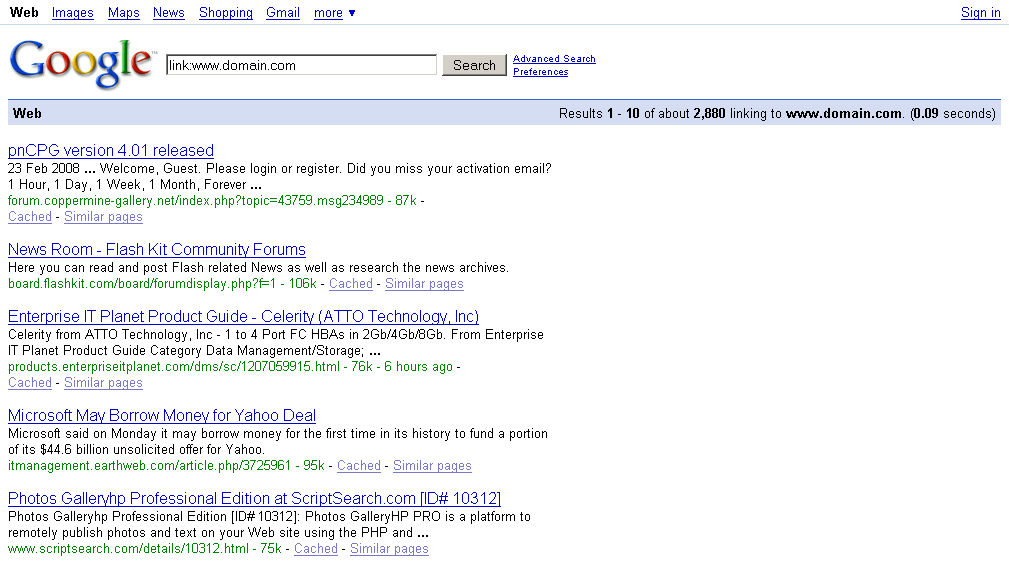
At Google Cheat Sheet or Google Advance Operators page, Google tells us a way to check links, a website have or more commonly known as back links. According to it you can check your website / web blog back links (ok a chunk of your website back links) by typing in the following query in Google.

link:www.domain.com

but if you search
link: www.domain.com
(Note: there is a space between : and url)

You will get an entirely different number of links.

Here is the images. You can see the visible different number of links.

WITH SPACE: | WITHOUT SPACE:
Click Here For Image | Click Here For Image


Those two queries shows a different number of same thing i.e. back links. Moreover if you are sign in with your Google account its shows you different number of links compare to when you search without signing in with your account.

So what is the reason behind it? Anyone knows?

Yahoo Answers And Search Engine Ranking!

0 comments

SEOSure you all know about Yahoo Answers. A user driven advance form of Forums.

At Yahoo Answers real people ask questions and real people answer those questions. So whats the big deal?


Now think as an black hat SEO..

Yahoo Answers can help in your site off page optimization. It not only drive targeted visitors to your website but also increase indexing and ranking in Search Engines.

Yes! Yahoo Answer is using NO-Follow Tags but still even a no-follow link from Yahoo Answer worth, secondly No-Follow Links gives you almost same advantage as a do follow link. Read Here

So to begin, create a new yahoo id with real name (not yours) and sign in at Yahoo Answers. Go Advance In search field, here type the keyword related to your website industry and then chose Open Question. Now hit Search.

This will bring you all the questions related to your website industry. Now, check which questions you can answer easily or the ones on which you have already created pages on your website. Answer those questions and if needed put your link with your answer and If you don't have a webpage on your website regarding the question, than give some informative website related url.

Yes! there are proven results of increase in ranking by using Yahoo Answers. The reason behind why Google gives important to a link from Yahoo Answer is simple i.e Relevancy And Uniqueness/Freshness.

So try yourself and see the results!
Don't Spam but use the service for good.

Negative Image Optimization And The Advantage!

0 comments

SEOWell unfortunately I am not a Black Hat SEO

And i didn't know bout black hat SEO tricks and tips.. but I guess using something for your advantage that you shouldn't may comes in black hat


But here is a a tip for you guys out there... in fact a proven tip..to increase your site ranking and authority with some unfair practice.


So have you heard of Image Optimization? Image Optimization is one of the major factod of Onpage SEO now but here I am giving you a rather differetn type Image Optimization that is Image Hot Linking.

Many of you already may know bout this thing and even experince it already but knowing bout something is a bit indifferent than how to do it correctly.

So basically what is Image hot linking?

Image Hot Linking is the name of process that involves using images of a website by directly linking to it. This can be done by using "img" tag and put the url of the image hosted on other website.

But what's so big about it?

Ok think that you are writing an article on Pet Care. Sure there are hundreds of articles already present on the web and almost all of them have related pictures too.

Now an article with some images, present on a web page having pagerank 6. Guess you all know what is pagerank, but a little intro doesn't harm anyone..

PageRank is a formula of Google, by which it determines the important of a web page. To rad complete and most comprehensive article on Google Page Rank, click here..

So a web page having 6 PageRank is a trusted thing in eyes of Google and all the links present on that page enjoying the transfer of that Pagerank juice..and yes..even the image.

So the image you are putting on your site is already getting Pagerank 6 juice and if you put it on your page, the flow of juice will directed to your page too.

Don't believe me ..try it out yourself and feel the difference.

Here is a tool to see which of your image is suffering hotlinking.
Image Hotlinking Checking Tool

NOTE: THIS ARTICLE IS FOR EDUCATIONAL PURPOSE ONLY.

DO IT NOW SEO TIPS

0 comments

!! WELCOME TO DO IT NOW SEO TIPS !!

HERE ARE SOME SEO TIPS FOR YOU WHICH YOU CAN START IMPLEMENTING EXACTLY AFTER READING THEM. THEY ARE PROVEN AND NEED NO HARD WORKING. JUST READ THEM AND START TRYING THEM RITE NOW!

1. IMAGE HOT-LINKING AND ITS EFFECT ON RANKING
2. IMPROVE RANKING BY USING YAHOO ANSWERS